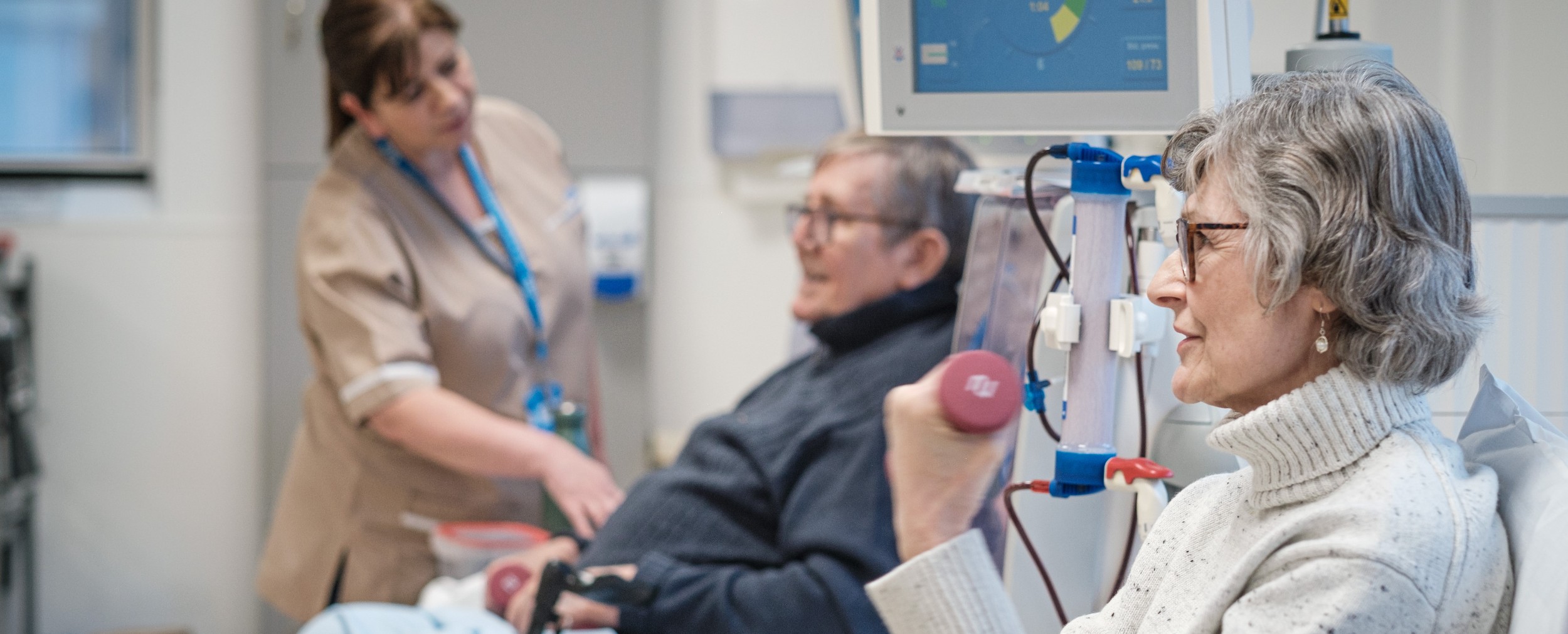
In this service we look after problems with the kidneys. The kidneys do a vital job to keep the body clean and balanced. They:
- Clean our blood by removing waste and extra water (which becomes wee).
- Keep the right balance of water, salts, and minerals.
- Help control blood pressure.
- Make hormones that help the body produce red blood cells and keep bones healthy.
We are one of only three Trusts in the region to provide this specialist service.
What conditions do we treat?
This is a long-term condition where the kidneys do not work as well as they should. It can get worse over time but many people with CKD can live long lives with the condition. Some people may need a kidney transplant. To find out more visit: Chronic kidney disease - NHS.
This is when your kidneys stop working in the right way. It happens all of a sudden when people are very poorly with something else. It can range from minor loss of kidney function, to complete kidney failure. To find out more visit: Acute kidney injury - NHS
What services do we provide?
This is where we find out what is wrong with your kidneys without having to do a big surgery. We also prepare you for dialysis if that is what you need. Our expert team can:
- Do kidney biopsies (take a tiny sample to check what is wrong). Click here to watch a video about this
- Use live pictures to see what is happening inside the body.
- Put in the tubes you will need for dialysis. There are two types of tube we can put in. This depends on what type of dialysis you want to do.
- Click here to watch a video about Peritoneal Dialysis (PD) catheter.
- Click here to watch a video about a Tunnelled Dialysis catheter.
- Fix problems with those tubes if they get blocked. Click here to watch a video about this.
You will usually go home on the same day as your procedure. You will stay for a few hours with us first to make sure everything is ok. It is a good idea to bring an overnight bag just in case you need to stay longer.
This is the treatment we use to clean your blood when your own kidneys cannot. A machine takes your blood through a tube (in your neck or arm), cleans it using an artificial kidney, and sends it back. It removes waste and extra water. It does not hurt. Most people need it 3–4 times a week, and each session lasts 3–4 hours.
You can choose to have this at home or in one of our centres. If you want to know more just ask one of our team, or your kidney consultant. We will help you decide what type of dialysis is best for you. Most people can do home dialysis if that is what they want. It is your choice.
Click on the links below for more information about the different types of dialysis:
Ask our team for access to the PatientsKnowBest (PKB) website. This will give you online access to your test results and stay in control of your dialysis care.
This is common for people with kidney disease.
It happens when your kidneys do not make enough of a hormone that helps produce red blood cells. These are the blood cels that carry oxygen around the body. If you do not have enough, this can make you feel tired, weak and be short of breath. This can impact on your quality of life.
We will support you so that your renal anaemia does not become a problem. There are two ways we can help your body to make more red blood cells. We will work with you and your kidney doctors to decide what is best for you:
- Iron supplements – you can take iron tablets in the first stages of your disease. We can also give you this via a drip. You will need to come to our renal ambulatory care unit. This will take about 1 hour.
- Hormone injections – these will help you to make more red blood cells. We will teach you how do this at home.
We will organise these treatments for you and help you keep in control. We are here to support your journey with kidney disease, for as long as you need us to.
We are here to support people under the care of our Renal team. We know that living with a kidney condition is life changing. This can be hard to manage sometimes but we have experts who can support you.
There are lots of reasons why people need our therapy and support:
- This might be to help with low mood or anxiety.
- It might be to help you adjust to life with kidney disease.
- Some people feel angry and this can take its toll on relationships.
- Other people find it hard to sleep.
We can help work through whatever is on your mind. Just let your kidney team know if you would like our help.
We can meet you and talk about the support we can offer. This will give you a chance to decide whether therapy is right for you. We can talk over the phone, via video or in person. It’s up to you. Together we will make a plan. The number of sessions you have will depend on your needs.
This service is not there for the long-term treatment of mental health conditions. If you are struggling, but it is not to do with your kidney disease, there is lots of help out there. Click here to access mental health services.
Where will my treatment take place?
Click on the links below for directions to our three centres:
- Durham Diagnostics and Treatment Centre
- Sunderland Royal Hospital - click here
- Washington Primary Care Centre.
Click on the links below to find out more about our clinics:
Our renal clinics at South Tyneside District Hospital run from the main outpatients department.
Our renal clinics at Sunderland Royal Hospital run from the Department of Renal Medicine. This is on on A level, with easiest access from Kayll road.
We run outpatient clinics from other Trust locations too (click here for directions). Your appointment letter will let you know which location to go to.
Where can I find out more?
Dialysis away from base - Help and advice for dialysis patients who would like to take a holiday:
- Leaflet - What to do if you are on dialysis and going on holiday in the UK
- Leaflet - What to do if you are on dialysis and going on holiday abroad
Grant application forms for Kidney Care UK to apply for funding towards holidays, domestic goods or hardship grants.
You can reach our secretaries Monday to Friday from 8:00am to 5:00pm. Call STSFT switchboard on 0191 565 6256 and use the extension numbers below:
- For Dr Davison, Dr Clark, Dr Andrews and Dr Ryan - ext 47296
- For Dr Fenwick, Dr McCloskey, Dr Hinchliffe and Dr Willows - ext 47226
- For Dr Palfrey, Dr Duffy and Dr Rudman - ext 41250
- For Dr Ahmed, Dr Srivastava and Dr Whitehead - ext 41466
- National Kidney Foundation - click here
- Kidney Care UK - click here
- Kidney Research UK - click here
- NHS Blood and Transplant - click here
- NHS Organ Donation - click here
- National Black, Asian, Mixed Race &Minority Ethnic Transplant Alliance (NBTA) - click here
- Transplant TV - click here
Our senior team in Renal Medicine
- Clinical Director - Dr Rauri Clark
- Divisional Director - Sheena Fish
- Directorate Manager - Liam McManus
- Matron - Deborah Carr
Contact us
- Renal reception 0191 565 6256 (ext 47309)
- Dialysis admin team 0191 5656256 (ext 47438)
We are here Monday to Friday from 8:30am to 4:30pm. Please let us know as soon as possible if you need to change or cancel your appointment.
- Renal ambulatory care 0191 565 6256 (ext 47430)
- Durham Dialysis Unit 0191 541 0265
- Washington Dialysis Unit 0191 5027552
There is an on-call consultant available 24/7 for urgent renal advice via the STSFT switchboard (0191 565 6256).
Watch the video below to meet our Renal team


Click on the donate button to give to our renal charity fund
Every penny makes a big difference to the lives of our renal patients.