
At South Tyneside and Sunderland NHS Foundation Trust we respect and value the diversity of our staff, patients, carers and visitors and we are committed to meeting the needs and expectations of the diverse communities we serve, providing high quality, safe care.
Our team offers support patients and staff at STSFT by creating an inclusive culture, where everyone feels valued. Click on the banner below to meet our Equality, Diversity and Inclusion team.
Meet our Equality, Diversity and Inclusion team
Phillipa Poole, Inclusion Lead
 What does your role entail? Every day is different in my job as we support staff, patients and our Trust Board to embed inclusion and to make sure we have fair access to services and opportunities.
When you joined the Trust? July 2019
Why you wanted to work for the NHS? To help make improvements for people who face challenges, discrimination or unfair access.
What you enjoy most about working at our Trust? I love the diversity of the role and how we are making improvements to support staff and patients.
How does your role promote inclusion? Through influencing and engaging people to think about inclusive leadership, respect and fairness.
Any other info you would like to share? I love traveling and going to places I have never been to before.
Jake Higgin, Inclusion Advisor
What does your role entail? My job is to help make our Trust as inclusive as possible and make sure we are welcoming for all our fantastic staff and patients. I work with our three staff networks, deliver inclusion training and offer advice and support to the Trust.
When you joined the Trust? April 2021
Why you wanted to work for the NHS? I've always wanted to work for an organisation that helps and supports people.
What you enjoy most about working at our Trust? I love working with and meeting lots of different people.
How does your role promote inclusion? I listen to the thoughts of our staff and patients to ensure we learn from their experiences.
Any other info you would like to share? I'm a massive Formula One follower and Lewis Hamilton is my personal hero!
Equality Act (2010) - Public Sector Equality Duty
The Equality Act 2010 (the Act) replaces previous anti-discrimination laws with a single Act. The Act’s aim is to simplify the law, remove inconsistencies and make it easier for people to understand and comply with. It aims to strengthen the law to help tackle discrimination and inequality. The majority of the Act came into force on 1 October 2010 and the Public Sector Equality Duty came into force on 5 April 2011. The Equality Duty ensures that all Public Bodies play their part in making society fairer by tackling discrimination and providing equal opportunities for all.
The Equality Duty makes sure that public bodies consider the needs of all individuals in their day-to-day work. This includes in shaping policy, delivering services and in relation to their own employees. As a public body, the Trust is governed by the Equality Act 2010. The Act contains nine protected characteristics, which cannot be used as a reason to treat someone unfairly:
- age
- disability
- gender reassignment (whether or not someone is trans)
- marriage or civil partnership (including same-gender marriage)
- pregnancy and maternity/paternity
- race or ethnicity
- religion or belief
- sex or gender
- sexual orientation
The Equality Duty asks us to think about how we can accommodate and support people who are disadvantaged or suffer inequality.
To do this, we:
- Ensure we have the information available to us to understand the needs of our staff, patients, service users, carers and local population.
- Continue to progress our Equality Objectives and aim to reduce and address inequalities
- Monitor and evaluate who uses our services, seek patient and staff feedback and measure our outcomes, continually seeking improvement.
- Learn from what we do – both when we do well and when we can improve
All our inclusion work and activities are monitored by the Trust’s Equality, Diversity and Inclusion Steering Group which meets bi monthly and reports to the Workforce Committee.
Training and support
Our Inclusion Team promote and provide training to a wide variety of audiences including staff, senior leaders, wards/ teams, community groups and patients. Topics include:
- Embedding Equality and Inclusion (Inclusive Leadership)
- Barriers to Equality and Unconscious Bias
- The Role of Equality Law and Legislation
- Allyship
- Recognising and Responding to Prejudice
- Introduction to Anti-Racist Practice
- Reasonable Adjustments
- Inclusive Language
Get in touch if you would like further information at Stsft.Inclusion@nhs.net
Contact details
If you have any suggestions on how we could work together, make improvements or offer feedback, please contact us.
You can email the inclusion team on Stsft.Inclusion@nhs.net or write to:
Equality Diversity and Inclusion Lead
Human Resources
Sunderland Royal Hospital
Kayll Road
Sunderland
SR4 7TP
Or call 0191 565 6256
Staff Networks
We have the following staff network at STSFT. If you are interested in joining please contact using the emails below:#
- Positive Health Network – stsft.positivehealth.staffnetwork@nhs.net
- LGBT+ Network – stsft.lgbtplus.staffnetwork@nhs.net
- Workforce Race Equality Network (WREN) stsft.wren.staffnetwork@nhs.net
NHS Rainbow Badge Pledges
Our amazing staff across South Tyneside and Sunderland NHS FT have been making inclusion pledges.
For staff that would like to show their support and wear a badge they can complete a pledge of inclusion.
By choosing to wear this badge, staff are sending a message to staff, visitors and patients that “you can talk to me.”
Staff aren’t expected to solve issues and concerns but will act as a friendly ear and will know how to signpost to support available.
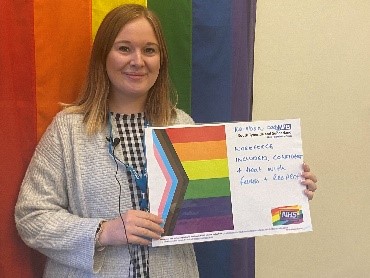
The South Tyneside and Sunderland NHS Foundation Trust pledge is as follows:
I confirm that...
- I understand wearing a badge gives a positive message of inclusion and means I have a responsibility to be someone who is a friendly ear for LGBT+ people and families
- I understand the purpose of the badge and that I have a responsibility to promote inclusivity, compassion and respect.
- I understand what to do if I think a situation requires escalation - support is available from line managers and further information is available on the intranet or via the inclusion team
- I understand that promoting inclusivity and valuing diversity will help create a culture that is open, honest and continuously improving.
- I am an employee of South Tyneside and Sunderland NHS Foundation Trust
Staff can complete the form on the intranet which can be found under the inclusion page;
Or download this form and send to Stsft.Inclusion@nhs.net or send to:
Inclusion Team, Human Resources
Trust Headquarters
Sunderland Royal Hospital
Kayll Road
Sunderland
SR4 7TP
Equality Delivery System (EDS)
The EDS is the foundation of equality improvement within the NHS. It is an accountable improvement tool for NHS organisations in England - in active conversations with patients, public, staff, staff networks, community groups and trade unions - to review and develop their services, workforces, and leadership. It provides a focus for organisations to assess the physical impact of discrimination, stress, and inequality, providing an opportunity for organisations to support a healthier and happier workforce, which will in turn increase the quality of care provided for patients and service users.
Please see the EDS submissions for STSFT which have been approved at Board:
Equality Delivery System - February 2026
Disability Confident
South Tyneside and Sunderland NHS Foundation Trust, which provides hospital and community services across the region, has been accredited as part of a national campaign to support disabled people into work.
Being awarded the Disability Confident standard demonstrates that South Tyneside and Sunderland NHS Foundation Trust has a positive attitude towards employing disabled people, and plays a leading role in changing attitudes towards disability.
As part of the scheme, the Trust has to commit to the following principles:
1. Actively looking to attract and recruit disabled people.
2. Providing a fully inclusive and accessible recruitment process.
3. Offering an interview to disabled people who meet the minimum criteria for the job.
4. Flexible when assessing people so disabled job applicants have the best opportunity to demonstrate that they can do the job.
5. Proactively offering and making reasonable adjustments as required.
6. Encouraging our suppliers and partner firms to be Disability Confident.
7. Ensuring employees have sufficient disability equality awareness training.
The Trust is committed to supporting disabled staff by:
1. Promoting a culture of being Disability Confident.
2. Supporting employees to manage their disabilities or health conditions.
3. Ensuring there are no barriers to the development and progression of disabled staff.
4. Ensuring managers are aware of how they can support staff that are sick or absent from work.
5. Valuing and listening to feedback from disabled staff.
6. Reviewing this Disability Confident employer self-assessment regularly.
Resources and reports
- Inclusion Conference Summary Report
- Hate Crime Conference Summary Report
- A Week of Rainbows Report EDS2 STSFT Grading
- Transgender Day of Visibility 2022 Report
- Sunderland Pride 2023 Report
- Download our Everyday Inclusion Strategy here - Equality, Diversity and Inclusion Strategy 2023-2027
- Download our EDI Policy here
Useful websites
- ACAS
- Access to work- Get support in work if you have a disability or health condition (Access to Work)
- Accessible Information Standard - NHS England » Accessible Information Standard
- Equality and Human Rights Commission- Equality and Human Rights Commission
- NHS England-Equality, diversity and health inequalities hub
- NHS England Reasonable Adjustments
- NHS Employers
- Equality Act 2010: Guidance Equality Act 2010 Guidance for Employers, workers, Service providers and Service users ·
- Fawcett Society
- Human rights and public law- Human rights and public law (1 Crown Office Row)
Mandated standards and Gender Pay Gap
Annually STSFT collates inclusion data from 1st April to 31st March.
This includes the following reports:
- Workforce Race Equality Standard (WRES)
- Workforce Disability Equality Standard (WDES)
- Ethnicity Pay Gap
- Inclusion Annual Report
In 2024 STSFT combined the reports into one document for WRES, WDES and Ethnicity Pay Gap.
Read our Inclusion Data Report for 2023/2024 here
Read our Inclusion Data Report for 2024/2025 here
WDES 2023 Report and Action Plan


